

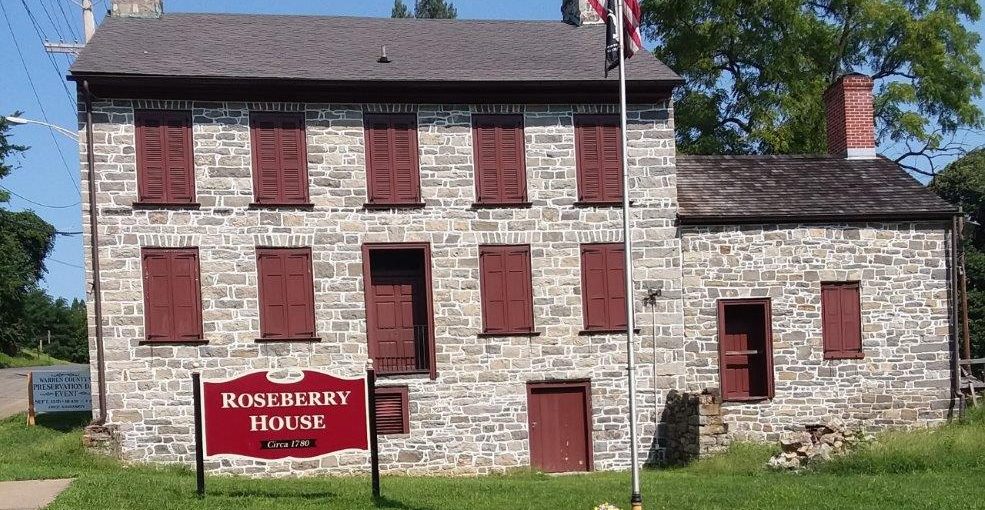
When we speak about Roseberry House, we are not simply talking about an old stone building. We are talking about a surviving connection to some of the earliest families, farms, and landholdings that helped shape what would eventually become Phillipsburg.
The Roseberry family was here long before Phillipsburg became the industrial and transportation center many people remember today.
The Roseberry Family Comes to Phillipsburg
The Warren History Trail reports that Roseberry brothers came from England and settled in the Phillipsburg area around 1750. John Roseberry later married a daughter of William Phillips, the early landowner whom the Town’s published history identifies as the most likely source of the Phillipsburg name.
The New Jersey Historic Trust describes the Roseberrys as a founding family of Phillipsburg. That wording recognizes their importance without suggesting that one family alone created the town.
The Roseberrys and the Land
Members of the Roseberry family accumulated substantial landholdings in the 18th century. Later, in 1853, the Phillipsburg Land Company purchased approximately 300 acres of the Roseberry farm and laid out 1,130 lots. That subdivision became one of the major turning points in the town’s growth.
Land that had been part of a large family farm began to become streets, homes, businesses, and neighborhoods.
Did the Roseberrys Build Roseberry House?
This is where the story becomes especially interesting.
The exact early construction history of Roseberry House is not completely settled. The New Jersey Historic Trust states that the house may have been constructed for John Tabor Kempe, Attorney General of New York, and his wife Grace Coxe. Kempe remained loyal to the British Crown during the American Revolution, and his property was confiscated. John Roseberry acquired the property in 1787.
The Warren History Trail dates the stone house broadly between 1765 and 1783 and notes that an attached kitchen was added around 1815. The National Register record identifies the property’s period of significance as 1750 to 1799 and recognizes both settlement and architectural significance.
So while we should not claim more certainty than the records support, we can say that the house became closely associated with the Roseberry family and with Phillipsburg’s earliest development.
A House From Another Phillipsburg
It can be difficult today to imagine Phillipsburg before the railroads, factories, streets, and densely built neighborhoods. For much of the Roseberry family’s era, the area was largely rural.
The transformation accelerated after the railroad reached Phillipsburg in 1852. The following year, the Phillipsburg Land Company purchased the large Roseberry farm tract and began dividing it into building lots. The town that grew around Roseberry House became dramatically different from the landscape the Roseberry family had known.
More Than Its Age
Roseberry House is significant for architecture as well as history. The New Jersey Historic Trust describes it as a stone Georgian style structure with American decorative wall painting on the interior. The Warren History Trail notes its five bay, two story plan and the later kitchen addition.
The house was placed on the New Jersey Register of Historic Places in 1972 and the National Register of Historic Places in 1973.
Why Roseberry House Matters
Roseberry House gives us something that documents and photographs alone cannot provide. It gives us a place where we can stand.
Its stone walls connect present day Phillipsburg with a community that existed before the railroad arrived, before much of the town was laid out, and before Phillipsburg became the industrial center remembered by later generations.
The Roseberry family owned significant portions of the land upon which Phillipsburg later grew. Their story is intertwined with the earliest development of the community, and the later subdivision of the Roseberry farm helped make possible the town’s rapid expansion.
Roseberry House survived that transformation. It survived changes in ownership, modernization, neglect, threats of demolition, and years of deterioration.
That is why preserving it matters. Roseberry House is not simply a house from Phillipsburg’s past. It is one of the places where the story of Phillipsburg can still be seen, studied, and experienced.
References and Further Reading
These sources are included so readers can explore the subject further and check the historical details for themselves.
- New Jersey Historic Trust – John Roseberry Homestead
https://www.nj.gov/dca/njht/funded/sitedetails/roseberryhouse.shtml - Explore Warren History Trail – Roseberry Gess House
https://www.warrenhistorytrail.org/roseberry-gess-house/ - Town of Phillipsburg – History
https://phillipsburgnj.org/home/history/ - National Park Service – John Roseberry Homestead National Register Record
https://npgallery.nps.gov/NRHP/AssetDetail/1db8d7d6-23b5-47f7-b073-86b62bfa70c1
Image Credits and Sources
Roseberry House photograph: Phillipsburg Area Historical Society
https://phillipsburghistorical.org/storage/2019/12/Roseberry-House-2019.jpg
National Register documentation: National Park Service
https://npgallery.nps.gov/NRHP/AssetDetail/1db8d7d6-23b5-47f7-b073-86b62bfa70c


No responses yet